
How Often Should a Legionella Risk Assessment Be Done?
One of the most common compliance questions we are asked, and one where the honest answer is not a single number. Here is what the law actually says, what triggers a review, and what most premises end up doing in practice.
Is there a legal interval?
No. Neither the Health and Safety at Work etc. Act 1974 nor the HSE’s Approved Code of Practice L8 sets a fixed number of months or years. What ACOP L8 requires is that the assessment is reviewed regularly, and specifically whenever there is reason to believe it is no longer valid.
That wording is deliberate. A small office with a simple mains-fed system and a care home with stored water, showers and vulnerable residents do not carry the same risk, and it would make little sense to tie them to the same interval.
So what do most premises do?
In practice, a two-year review cycle has become the common benchmark for many commercial and residential premises in the UK. It is a convention rather than a legal requirement, and it is only appropriate where nothing about the system or its use has changed in the meantime.
Higher-risk settings are usually reviewed more frequently. Healthcare and care environments, buildings with complex or extensively stored water, and sites with a history of positive sample results typically operate on a shorter cycle set by their own risk assessment.
What triggers a review before the cycle is due?
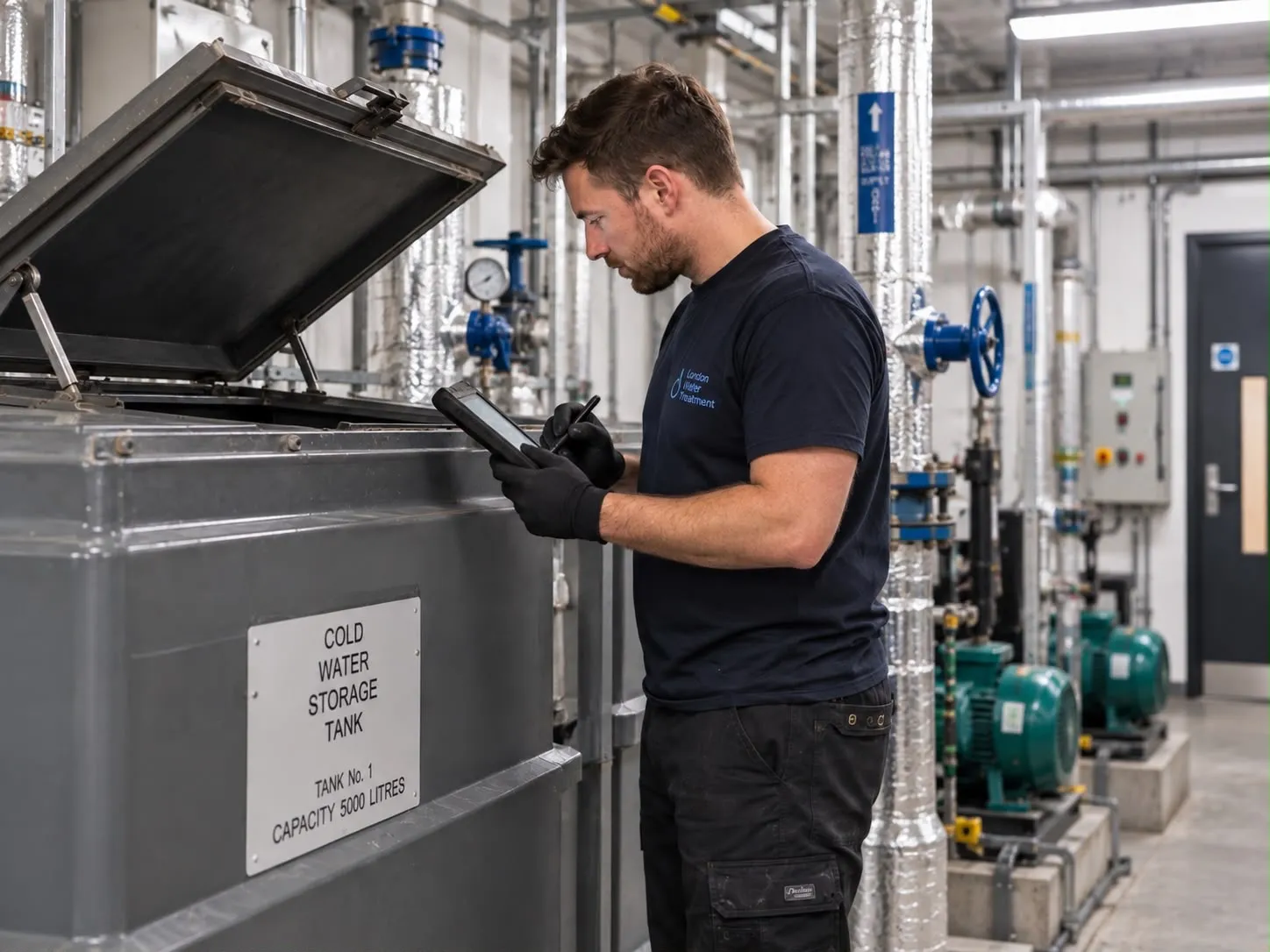
The interval matters far less than the triggers. Your assessment should be revisited whenever any of the following happen:
- Changes to the water system: new pipework, a replaced tank or calorifier, altered pipe runs, or anything that creates a dead leg.
- Changes to how the building is used: a change of occupancy, a new wing brought into service, or areas taken out of use.
- Periods of low or no use: extended closures, vacant floors, or seasonal shutdowns that allow water to stagnate.
- Control measures no longer effective: temperatures drifting out of range, or monitoring records showing repeated failures.
- A positive sample result: particularly one indicating the system is not under control.
- A suspected or confirmed case of legionellosis associated with the premises.
- New information about risks or control measures relevant to your system.
Several of those are easy to miss without a monitoring regime running underneath. Routine checks are what surface a drifting temperature or a failing control long before a review is formally due. See our guide to water hygiene monitoring.
Review or full reassessment?
These are not the same thing, and the distinction affects both cost and time.
A review confirms whether the existing assessment is still valid: has anything changed, are the control measures still appropriate, are the records in order. Where nothing significant has changed, a review may simply update and re-date the existing document.
A full reassessment is a fresh survey of the system, producing a new asset register, schematic and risk ratings. That is usually needed after significant alterations, a change of use, or where the previous assessment is substantially out of date or of poor quality. It is also why review costs and first-assessment costs differ. See what affects the cost of a Legionella risk assessment.
Who decides the frequency?
The duty holder. That is usually the employer, building owner, landlord or managing agent, and the responsibility cannot be delegated away even when the work itself is carried out by a contractor.
In practice the frequency should be set by the assessment itself. A competent assessment will state when it should next be reviewed, based on the risk it found. If your current document does not say, that is worth querying. Our guide to what a Legionella risk assessment involves and who needs one covers what a good one should contain.
Getting your review scheduled in London
London Water Treatment carries out Legionella risk assessments and reviews across London for offices, care homes, schools, landlords and managing agents, including UKAS-accredited sampling where it is needed. Get in touch if your assessment is approaching its review date, or if something about your system has changed.
Frequently asked questions
Is a Legionella risk assessment legally required every two years?
No. Two years is a widely used industry convention, not a legal interval. ACOP L8 requires the assessment to be reviewed regularly and whenever there is reason to believe it is no longer valid, which can be sooner or later than two years depending on your system.
Do landlords need a new assessment for every tenancy?
Not usually. For most domestic rented properties with simple systems, the existing assessment remains valid provided nothing has changed. A change of tenancy that leaves the property empty for a long period, or any alteration to the water system, would be a trigger to review.
What if my assessment has lapsed?
Arrange a review as soon as practical. An out-of-date assessment is a common finding at audit, and if the system has changed since it was written it may no longer reflect the actual risk.