
Water Tank Disinfection: What It Is and When You Need It
If your risk assessment has flagged it, or a water sample has come back positive, you may need water tank disinfection. It is often confused with cleaning, and many building managers are unsure when it is actually needed. Here is what it is, when it is required, and how the process works.
What is water tank disinfection?
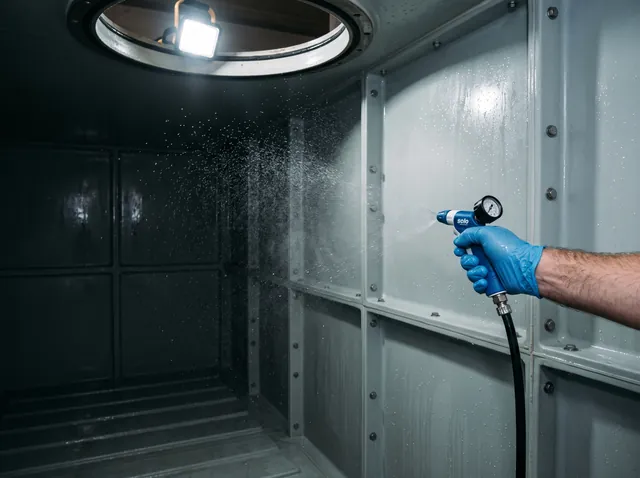
Water tank disinfection is the controlled chemical treatment of a cold water storage tank and its associated pipework to destroy bacteria, including Legionella, and make the stored water safe to use. It is usually carried out by chlorination, it most often follows a physical clean of the tank, and the result is confirmed by laboratory analysis of a water sample.
A cold water storage tank is the point in a building’s water system where water stops moving. It sits, it warms towards room temperature, and anything that has entered the tank settles on the base. That is exactly the condition in which bacteria multiply. Disinfection is not a continuous treatment and it does not protect a tank indefinitely. It is a one off operation carried out at a defined moment, and it holds only as long as the conditions that caused the problem stay under control. For everything we do on stored water systems, see our water tank services.
Disinfection versus cleaning: what is the difference?
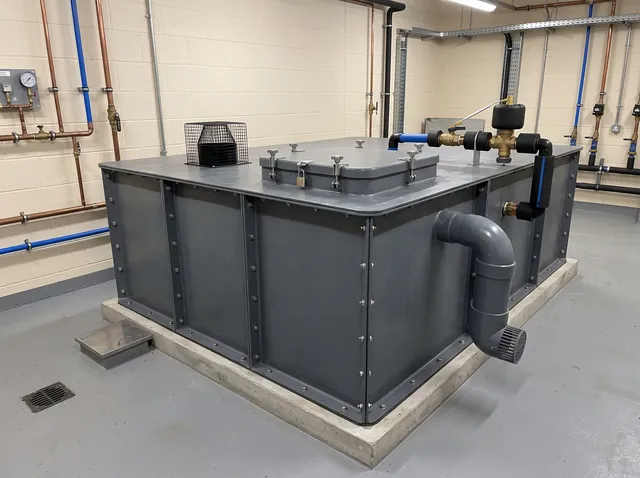
Cleaning and disinfection are two stages of the same job, not alternatives. Cleaning physically removes sediment, scale, debris and biofilm from the tank surfaces. Disinfection then kills the bacteria left on those surfaces and in the water. Disinfecting a tank that is still dirty does not work, because debris shields bacteria from the chlorine and consumes it.
| Cleaning | Disinfection | |
|---|---|---|
| What it does | Removes what is physically in the tank. | Destroys the bacteria that remain. |
| How | Drain down, manual sediment removal, scrub and vacuum out. | Refill and dose with chlorine, held for a set contact time. |
| Deals with | Silt, rust, scale, insects, building debris, biofilm. | Bacteria on the tank walls, in the pipework and in the water. |
| Evidence | Report on tank condition before and after. | Laboratory sample result, plus certification on a new system. |
A competent contractor quotes for both together and treats them as one visit. For how the physical stage runs, and what the engineer looks for while the tank is empty, see water tank cleaning.
When do you need water tank disinfection?
Disinfection is triggered by an event or a finding, not by the calendar.
- After a tank clean As the second stage of the service, treating the surfaces the clean has just exposed.
- On a new tank Before it is brought into use. A new tank has been transported, stored and installed on an open building site.
- After a positive sample Where analysis finds Legionella or an unsatisfactory bacterial count, or where there is other evidence of contamination.
- After remedial work Liner repairs, replacement float valves, new pipe runs and lid work all expose the inside of the system.
- After a period out of use Where a building has stood empty or water has been left standing. Stagnation reliably loses control of a system.
- Where your risk assessment says so Acting on the recommendation is the whole point of having the assessment carried out.
There is no statute in Great Britain called the Legionella Regulations. The duty comes from general health and safety law, principally the Health and Safety at Work etc. Act 1974 and the Control of Substances Hazardous to Health Regulations 2002, with the Approved Code of Practice L8 setting out how to comply and HSG274 Part 2 giving the technical detail for hot and cold water systems. None of that prescribes a disinfection interval. What it requires is a suitable and sufficient risk assessment, and that you act on what it finds. If you have not had one, start with Legionella risk assessments in London.
How the disinfection process works
Every stage exists for a reason, and skipping one undermines the stages after it.
- Plan and isolate Confirm tank size and construction, isolation points, and how the building manages while the water is off.
- Drain and clean Sediment, scale, debris and biofilm are removed from the base and walls, which is what makes the disinfection effective rather than nominal.
- Inspect while empty Corrosion, failing coatings, poor lid fit, missing insect screens and damaged insulation are recorded, because they are why a tank goes out of control again.
- Refill and dose The system is dosed with chlorine to a controlled concentration. Concentration and contact time are paired, a higher dose held for a shorter period and a lower dose for longer.
- Hold the contact period The solution is held against the tank and the pipework, with outlets drawn through so it reaches the distribution system as well.
- Monitor the residual Levels are checked around the system, not only at the dosing point, to confirm the concentration held everywhere.
- Flush down The system is flushed until chlorine returns to normal levels and the water is fit to use, with the discharge handled safely.
- Sample and confirm A sample goes to a UKAS accredited laboratory, which is the independent confirmation that the work achieved what it should.
A single domestic sized tank is normally a same day job. A large sectional tank, or a set of tanks serving a commercial building, needs longer on site and a longer water off window. The laboratory then adds time, so confirmation follows the visit rather than arriving with it. If a sample comes back unsatisfactory the system is re-treated and resampled, but a tank that fails repeatedly is usually telling you something structural: a lid that does not seal, or a tank so oversized for demand that water stands too long.
What documentation you get
You should receive a written record of the disinfection and the laboratory analysis confirming it. Where the work is part of commissioning a new or modified system, that record takes the form of a chlorination certificate. Keep both, because they are the evidence you will be asked for at your next audit or inspection.
What the paperwork should tell you
The tank or system treated and where it is, the date, the method used with concentration and contact time, the readings taken, the sample points, the laboratory results with the name of the UKAS accredited laboratory, and any remedial recommendations arising from the inspection.
Under ACOP L8 the dutyholder has to keep records of the precautions taken, so in compliance terms a disinfection with no paperwork is one that cannot be shown to have happened. For what the certificate covers and who asks to see it, read our guide to the chlorination certificate.
Keeping tanks safe between disinfections
Good tank hygiene reduces how often disinfection is needed, and most of it is basic.
- A close fitting lid It should seal and stay on. A poor lid lets in dust, insects and light.
- Insect screens Fitted to the overflow, warning pipe and any vent, so the tank is not open to the loft.
- Insulation Insulated and sited so stored cold water stays below 20C. Warm stored water is the condition most likely to lose control of a tank.
- Turnover Water should move through. A tank oversized for actual demand leaves water standing too long.
- Regular inspection Look inside on a set schedule and clean when the inspection shows it is due.
- Records kept together Inspections, cleaning records, laboratory results and temperature monitoring in one place.
Across several buildings or a portfolio, a periodic review of the whole regime is usually more useful than another one off visit. See water hygiene audits for what that covers.
How often should a tank be disinfected?
There is no fixed interval that applies to every tank. Frequency is driven by your Legionella risk assessment and by the condition found at inspection. Cold water storage tanks are commonly inspected annually, then cleaned and disinfected when that inspection shows it is needed, or when an event such as a failed sample forces it.
That answer surprises people who expect a number, but it follows from how the law is written. ACOP L8 makes the risk assessment the mechanism, and the assessment reflects your building: the condition of the tank, the temperatures actually achieved, how much water the building uses, who occupies it and what your sampling history shows. Two tanks of the same size in the same street can justify very different schedules. What is not defensible is having no schedule, or one nobody has reviewed since the building changed use.
Frequently asked questions
How often should a water tank be disinfected?
There is no fixed interval for every tank. It is driven by your risk assessment and the condition found at inspection. Cold water storage tanks are commonly inspected annually and cleaned and disinfected when the inspection shows it is needed.
Do you get a certificate after disinfection?
For new or modified systems, disinfection is usually confirmed with a chlorination certificate, backed by a satisfactory water sample from a UKAS accredited laboratory. For an existing tank you should still receive a written record of the work and the laboratory result.
Arrange tank disinfection in London
London Water Treatment provides tank cleaning and disinfection for residential and commercial properties across London and the surrounding areas, from our base in Brentford. Sampling is analysed by a UKAS accredited laboratory, and you receive the result along with a record of the work and of anything found while the tank was open.
Tell us the property type, the number and rough size of the tanks, whether the disinfection follows a clean, a failed sample or remedial work, and any date the confirmation is needed by. Call 020 4532 7773, or arrange tank disinfection using the enquiry form. Where new or altered pipework is involved too, see our chlorination services in London.
Need a tank cleaned and disinfected?
Tell us what the risk assessment or the sample result said, and we will tell you what the work involves and how long it takes.