
What Is a Legionella Risk Assessment and Who Needs One?
If you have been told you need a Legionella risk assessment, this guide explains what one is, what it covers, who is legally required to have one, how often it is reviewed and what happens next.
What is Legionella?
Legionella is a bacterium found naturally in fresh water such as rivers and lakes, where it is harmless. It becomes a hazard when it enters a man made water system and multiplies. Water containing the bacteria that is turned into a fine spray and inhaled can cause Legionnaires’ disease, a serious pneumonia.
It can also cause Pontiac fever, a milder illness. Risk is highest for older adults and people with underlying health conditions. Exposure comes from inhaling an aerosol, not from drinking, which is why showers and spray taps matter most. Three conditions let the bacteria multiply, and they usually appear together.
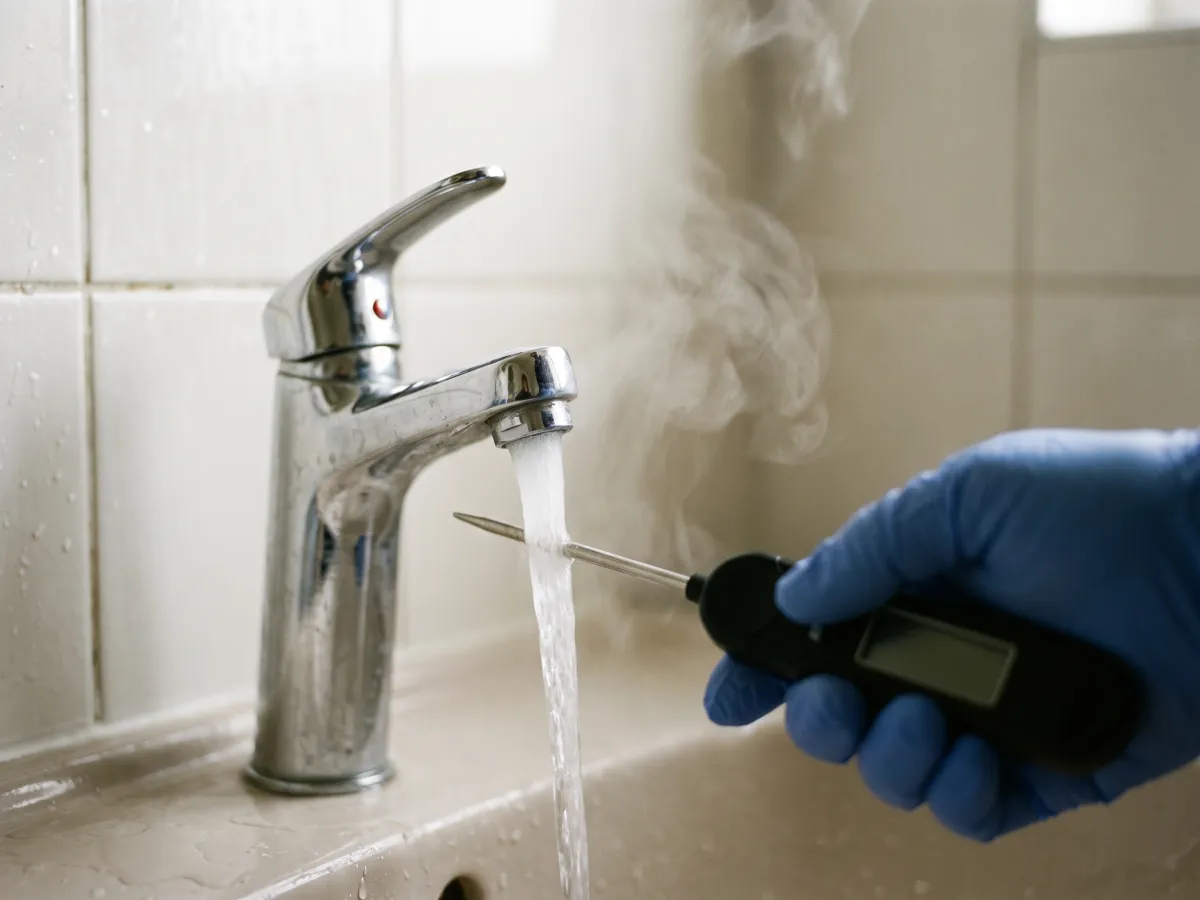
- Temperature Legionella multiplies roughly between 20°C and 45°C. Cold water above 20°C and hot water running cool are the common failings.
- Stagnation Water sitting in a tank, a little used outlet or a dead leg loses its disinfectant residual.
- Nutrients Sediment, scale, rust and biofilm give the bacteria something to feed on.
What is a Legionella risk assessment?
A Legionella risk assessment is a formal evaluation of a property’s water system that identifies whether conditions exist which could allow Legionella bacteria to develop, who could be exposed, and what control measures are needed to manage that risk. It is carried out on site by a competent person and written up as a report.
It is the first thing the law expects of you. The Approved Code of Practice L8, published by the Health and Safety Executive, states the duty:
A suitable and sufficient assessment must be carried out to identify and assess the risk of exposure to legionella bacteria from work activities and water systems on the premises and any precautionary measures needed.
ACOP L8, fourth edition, paragraph 28
L8 is not an Act of Parliament. It is an Approved Code of Practice with a special legal status: if you are prosecuted and did not follow it, you must prove you complied some other way or a court will find you at fault. All systems need an assessment, though not all need elaborate controls. More on your legal duties on Legionella.
The assessment is a survey of where risk could arise. Laboratory analysis of samples is separate work, and the assessment decides whether it is needed at all: see Legionella testing and water sampling.
What the assessment looks at
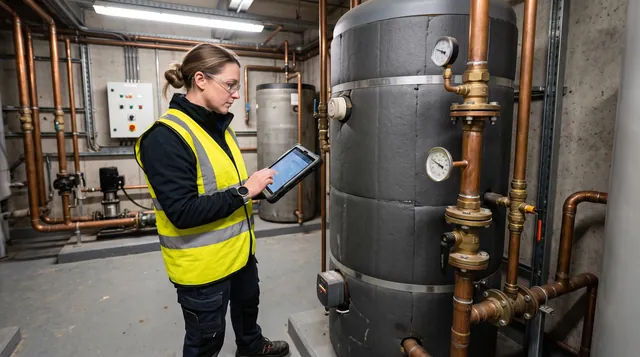
The assessor works from the incoming main to the furthest outlet, recording what is installed rather than what the drawings say.
- Cold water storage tanks Lid and screens, insulation, sediment, corrosion and stored temperature. Usually the biggest single risk.
- Cylinders and calorifiers Storage and distribution temperatures, stratification, and sludge at the base.
- Pipework and dead legs Redundant runs left after a refurbishment hold water that never moves.
- Outlets Showers, spray taps and hoses that create an aerosol, and outlets rarely used.
- Temperatures Readings at the tank, the cylinder and the nearest and furthest outlets.
- Use and occupancy Which parts are empty or seasonal, and whether users are more vulnerable.
- Records and management Previous work, monitoring logs, who does the flushing and temperature checks, and whether the records would survive inspection.
What the report contains
The report describes the water system as found, identifies the risks present, categorises them by level of concern and sets out the recommended remedial actions. It should also record the temperatures observed, name the person who carried out the assessment, and state when it should next be reviewed.
A report worth paying for is specific to your building: findings recorded asset by asset rather than on a generic checklist, a risk rating against each one, and prioritised actions with timescales. It is what you show an enforcing authority, an insurer or an incoming tenant. Our assessments follow ACOP L8 and BS8558, with full written documentation on completion.
Who is legally required to have one?
Anyone who is a dutyholder under health and safety law: employers, self employed people, and anyone in control of premises in connection with work, including landlords and managing agents. In practice that covers almost all commercial premises and residential property that is let, from a managed block down to a single flat.
There is no Act called the Legionella Act. The duty comes from the Health and Safety at Work etc. Act 1974 and the Control of Substances Hazardous to Health Regulations 2002, under which Legionella is a substance hazardous to health.
Responsibility cannot be contracted away
L8 puts it plainly: a duty under section 3 of the 1974 Act cannot be passed on by means of a contract. You can appoint an agent or a specialist to do the work, but the duty stays with you.
Commercial premises
If you own, occupy or manage a commercial building with a water system, you need a current assessment and must manage what it identifies. Offices, shops, hotels, gyms, schools, care and healthcare premises are all in scope, and those serving vulnerable people are monitored more closely.
Residential landlords
Often misunderstood, but the duty is real. HSE guidance is clear that landlords of domestic rental property must assess and control the risk, whether you hold a portfolio or let one flat. A property with no stored water is a smaller job, not an exemption. See Legionella risk assessments for landlords.
Empty and part occupied buildings
A vacant property does not fall outside the duty, and is usually a higher risk, because nothing draws water through the system. See Legionella risk in vacant properties.
How often does it need to be done?
There is no fixed interval in ACOP L8. The requirement is that the assessment is reviewed regularly and updated whenever there is reason to believe it is no longer valid. Two years is the baseline most water hygiene professionals work to, but any significant change to the system, its use or its occupancy should trigger a review sooner.
Treat the calendar as the backstop, not the trigger. A review is due whenever any of these happens:
- A significant change to the system: new pipework, a new tank or cylinder, a refurbishment.
- A change of use, occupancy or tenant, an extended vacancy or a shutdown.
- Monitoring results showing control is not holding, usually temperatures out of range.
- A positive sample, or a case of Legionnaires’ disease associated with the property.
A review is not automatically a full reassessment. Where nothing has changed, it can confirm the existing assessment remains valid, and that is recorded.
Who can carry one out?
A competent person. ACOP L8 requires the dutyholder to ensure that whoever carries out the risk assessment and advises on prevention and control of exposure is competent to do so. Competence means real knowledge and experience of water systems and Legionella control, and enough understanding of the installation to give advice that can be acted on.
The dutyholder must also appoint a responsible person, in writing, to manage the control scheme day to day. Before booking, ask who will attend, what water hygiene experience they hold, and whether the work follows ACOP L8 and HSG274 Part 2. For anything with tanks, a calorifier or vulnerable occupants, use a specialist. If you are comparing quotes, read how much a Legionella risk assessment costs.
What happens after the assessment
You act on the findings. Anything flagged as an immediate risk is dealt with promptly, lower priority actions are scheduled into a written control scheme, and the report is filed with your water safety records. Where the system is found in good order, the record is still the outcome, and it still has to be kept.
- Deal with the urgent items Usually a contaminated tank, temperatures out of range, or a spray outlet on an uncontrolled system.
- Write the control scheme Temperature regimes, flushing, tank inspections, cleaning intervals and who does what.
- Carry out the remedial work Commonly a tank clean and disinfection, chlorination, or temperature corrections.
- Monitor and record Temperature checks and flushing logs evidence that the scheme is being run.
- Review Revisit at the stated interval, sooner if the system or its use changes.
Where there is stored water, the usual follow on works are water tank cleaning and disinfection. Where pipework is contaminated or altered, the answer is chlorination services in London, with certification on completion.
Arranging a Legionella risk assessment in London
We offer same day Legionella risk assessments across London for residential and commercial properties, with full written reports on completion, whether it is a single flat, a portfolio or a large building.
Have a few details ready: the property type and rough size, whether there is a cold water storage tank or a calorifier, and whether you hold a previous assessment. Call 020 4532 7773 or book an assessment using the enquiry form. For the full service, see our Legionella risk assessments in London.
Not sure whether you need one?
Tell us the property type and what is installed, and we will tell you what the assessment would cover before you commit to anything.